- What is a sonata?
- What do we mean by a “Sonata Series”?
An academic definition goes like this:
The sonata is a solo or chamber instrumental cycle of aesthetic or diversional purpose, consisting of several contrasting movements that are based on relatively extended designs in “absolute” music.
William S. Newman, author of the “History of the Sonata idea”
It is a good definition, but a quick look into the history of the word might be more useful to get us started.
Etymologically, “Sonata” comes from the verb sonare (to sound) to differentiate music made by instruments from vocal music. A Sonata is thus in contrast to Cantata, from the verb cantare (to sing).
Historically, the word thus started as canzone da sonar (a song to be “sounded”, instead of sung), and in his book “Chamber Music”, Homer Ulrich explains how the Baroque sonata form was the child of both vocal music and dance music. In the 17th century, he explains how Canzone became Sonata da Chiesa (vocal music was adapted into instrumental music for church) and how Dance Suites became Sonata da Camera (Camera = chamber). Over the years, the character of these two forms (da Chiesa and da Camera) borrowed from each other to converge towards the “Sonata” as defined in the Baroque and Classical period. In Ulrich’ table below, he sums up the combinations of what we today consider chamber music.
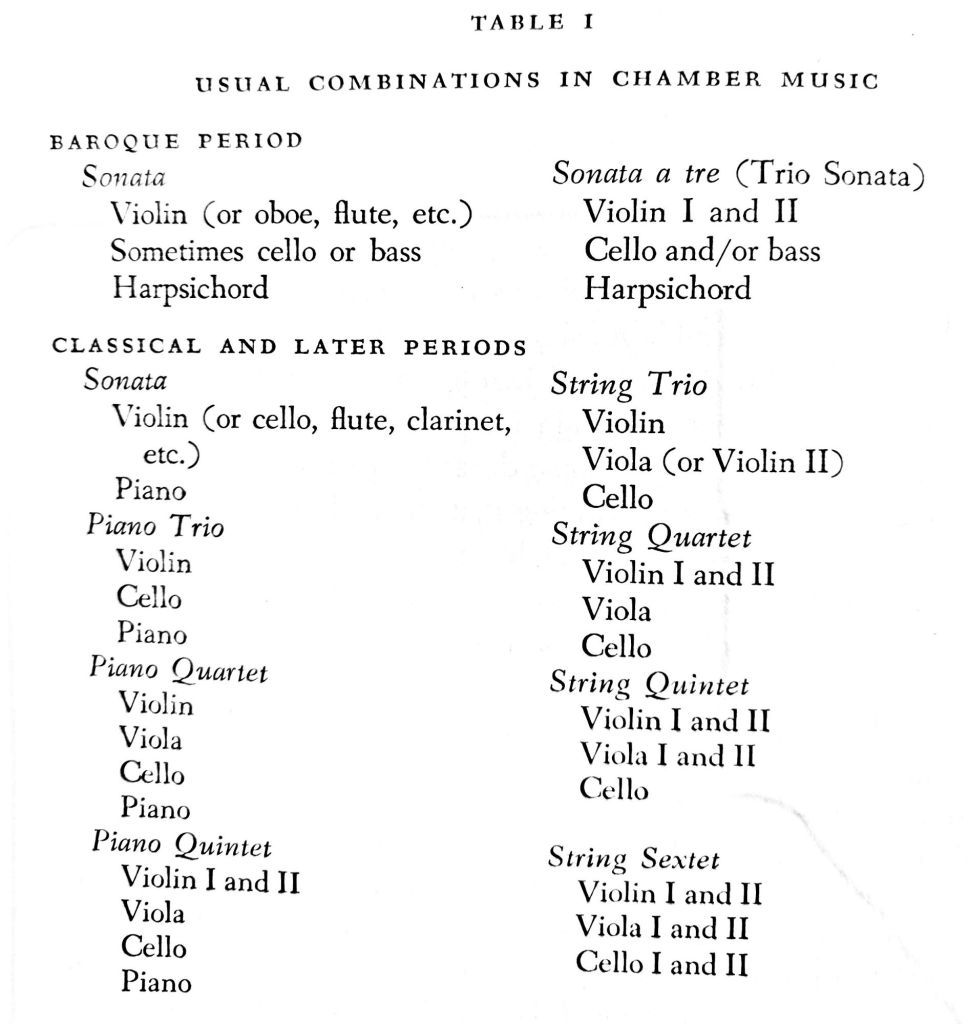
UP CLOSE AND CLASSICAL Sonata Series thus aims to present a different side of chamber music than the string and woodwind quartets and quintets which have been our focus for two years. The “Sonata Series” name thus seeks a contrast with our “Ensemble” concerts, but also a glimpse into the rich history of the sonata idea. As you will see from our programming, we consider that history to be ongoing… The sonata idea is alive and well!…
Our first Sonata Series concerts on February 28th and March 1st will feature:
- The instruments and instrumentalists: the oboe and the piano, played respectively by virtuosi Rong-Huey Liu and Vivian Liu.
- The role of celebrity musicians in the creation and accessibility of new music. As today Yo-Yo Ma and Izhtak Perlman represent cello and violin for the larger public, in the 19th century, Clara Schumann, herself a famous pianist, composed her Three Romances for famous violinist Joseph Joachim. Early in the 20th century, Hamilton Harty composed his Three miniatures for Leon Goosens, who was THE oboist of that period…
- The relationship between the voice and the oboe. In his position as the successor of Johann Sebastian Bach as St Thomas’s Cantor in Leipzig, Gustav Schreck wrote mostly choral music. The few chamber music pieces he wrote were for woodwinds, as they complemented his love of vocal music the best.
- The alive-and-well tradition of composing Sonatas, with Miguel Del Aguila, born in 1957. Living composers like Del Aguila have website where they can explain in their own words their vision for chamber music in the 21st century: (click for Miguel Del Aguila’s website).
Thank you for reading! Hervé

 UP CLOSE AND CLASSICAL
Leave a reply to januwine Cancel reply