UP CLOSE AND CLASSICAL’S next concerts on February 28th and March 1st will feature Three Romances* by Clara Schumann, opus 22, played on the oboe and piano.
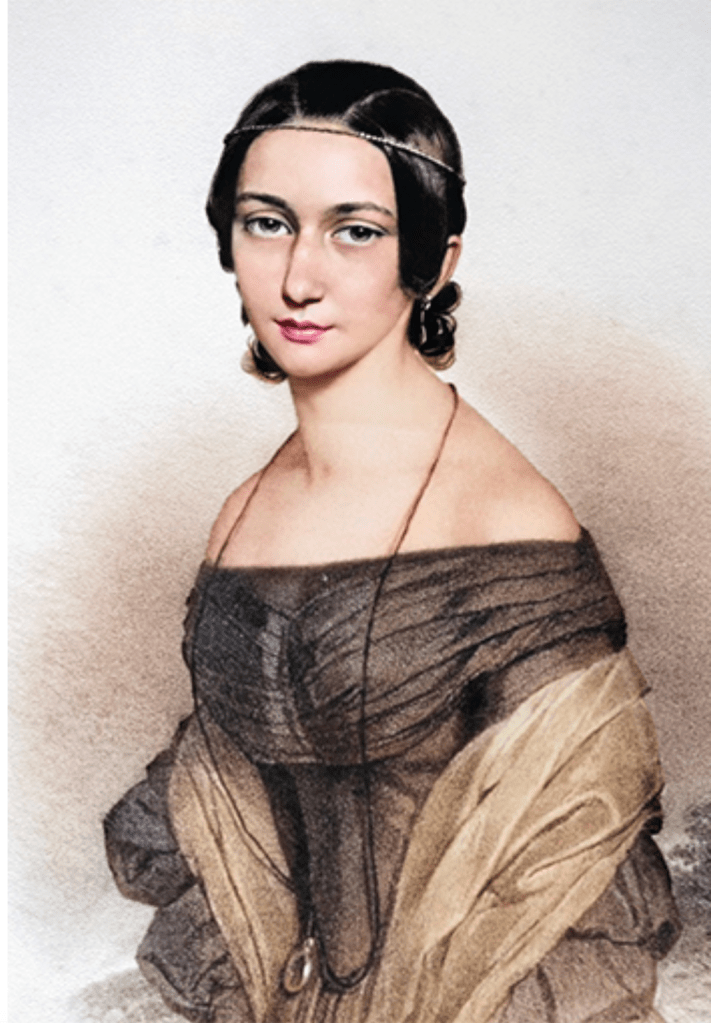
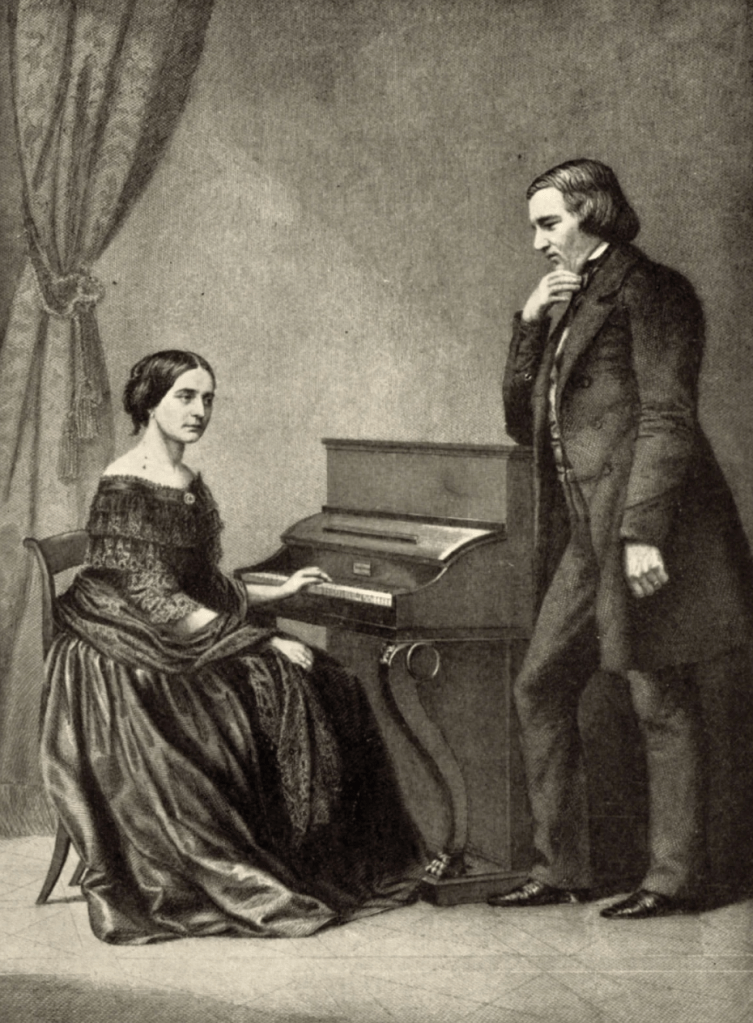
Clara SCHUMANN (1819-1896) was the foremost woman pianist in Europe, the devoted wife of Schumann and a beloved friend of Johannes Brahms.
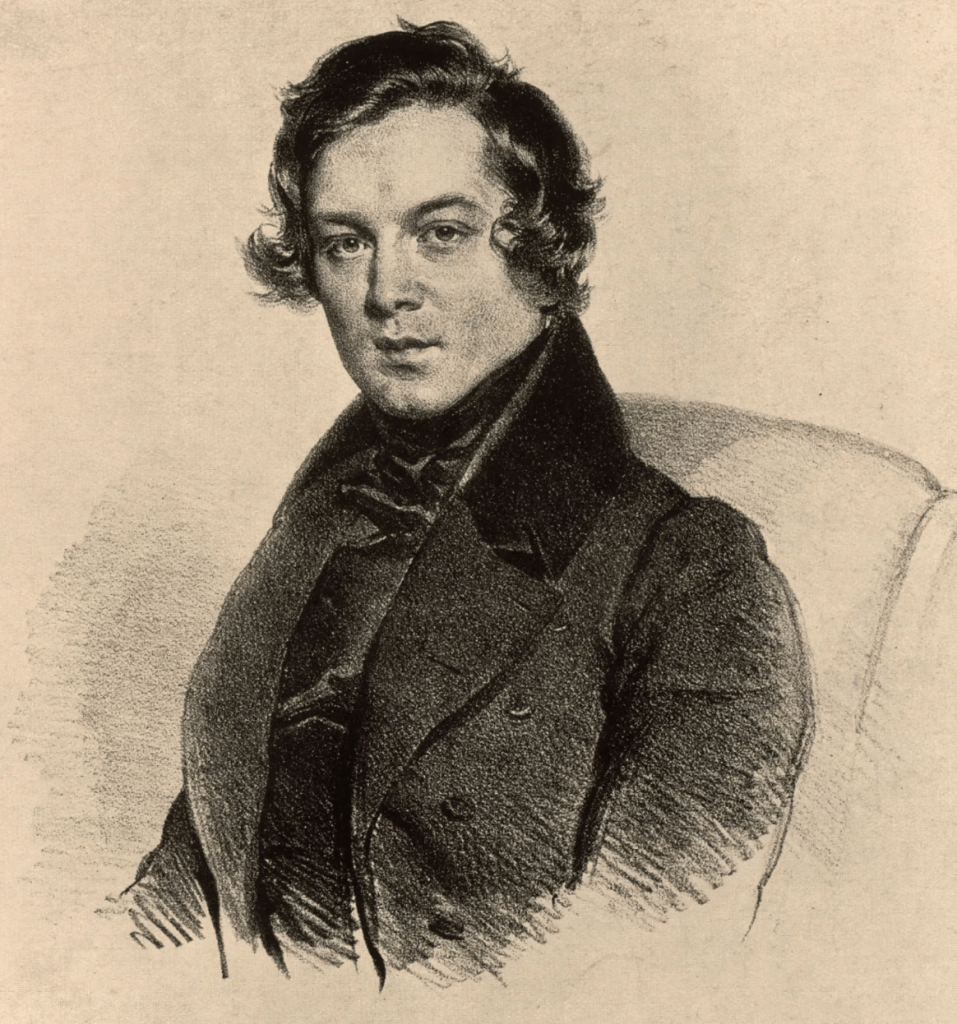
Robert SCHUMANN (1810-1856), a German Romantic, composed piano works while courting Clara Wieck, daughter of his piano teacher who violently opposed their union. From 1854 he was confined to an asylum.
Robert and Clara had eight children together.
*These romances were written for Joseph Joachim (1831-1907), the foremost violinist of that time mentioned in one of the stories below.
Below are entries from Norman Lebrecht’s “The Book of Musical Anecdotes” about Robert and Clara Schumann.
At an evening party at the house of the family Preusser of Leipzig… among the works performed was Robert Schumann’s quintet, in which Madame Schumann took the pianoforte part. In all this is, of course, nothing unusual; but the reader may perhaps think it sufficiently remarkable that the composer, to prevent his wife, a great pianist,
from hurrying the tempi, beat time on her shoulders.
—–
A large number of friends had been invited to hear Mendelssohn, Clara Schumann amongst them. He played Beethoven’s great F minor Sonata (‘Appassionata’); at the end of the Andante he let the final chord of the diminished seventh ring on for a long time, as if he wanted to impress it very forcibly on all present; then he quietly got up, and turning to Madame Schumann, said ‘You must play the Finale.’ She strongly protested. Meanwhile all were awaiting the issue with the utmost tension, the chord of the diminished seventh hovering over our* heads all the time like the sword of Damocles. I think it was chiefly the nervous, uncomfortable feeling of this unresolved discord which at last moved Madame Schumann to yield to Mendelssohn’s entreaties.
—–
When Robert Schumann had just finished [the piano quintet] Liszt unexpectedly came to Leipzig and insisted on hearing it performed the same night. ‘It was difficult,’ Clara Schumann told us, ‘to get four other artists to come at such short notice, but I took a cab and drove about Leipzig until I was fortunate enough to succeed in my mission.’ It was arranged that the performance should take place at 7 o’clock that evening at the Schumanns’ house. At that hour all were assembled with the exception of Liszt, who did not make his appearance until 9 o’clock. The quintet was duly played, but at the end Liszt moved towards Schumann and, patronizingly touching his shoulder, exclaimed: ‘No, no, my dear Schumann, this is not the real thing; it is only Kapellmeister music.’ At supper afterwards Liszt indulged in some deprecatory remarks about Mendelssohn. Schumann immediately rose, seized Liszt by the shoulder, and cried, ‘How dare you talk like that of our great Mendelssohn!’ He then left the room. Liszt, the polished man of the world, also rose, and, bowing low to Clara Schumann, said: ‘I am deeply sorry to have been the cause of such an unpleasant incident. I feel I am in the wrong place here; pray accept my humble excuses and allow me to depart.’
—–
Once, when expecting a visit from Joseph Joachim, Schumann jokingly proposed our composing a violin sonata all together, and then letting Joachim guess who was the author of each movement. The first movement fell to me,† the intermezzo and finale were composed by Schumann, whilst Brahms wrote the scherzo on a theme from my first movement. After having played the sonata with Clara Schumann, Joachim immediately recognized the author of each part.
The manuscript of this joint production was presented to Joachim, Schumann writing the following dedication: F. A. E.*
‘In Erwartung der Ankunft des verehrten und geliebten Freundes JOSEF JOACHIM; schrieben diese Sonate ROBERT SCHUMANN, JOHANNES BRAHMS, ALBERT DIETRICH.”
In expectation of the arrival of their revered and beloved friend, Joseph Joachim, this sonata was written by R.S., J.B., A.D.*F.A.E: ‘Frei aber einsam’ [free but lonely] – Joachim’s motto.
† Albert Hermann Dietrich (1829-1908) German composer and conductor.
—–
Madame Schumann had played at one of the [Düsseldorf] subscription concerts some unaccompanied solo pieces. Her husband sat not far from her, behind the piano. When she had finished there was a general rivalry among the audience and the musicians on the platform to give expression to their delight, which she, however, little heeded, for she saw her husband motionless and cold. ‘Have I not played well, Robert?’ But there came no response, and she wept whilst the hall was ringing with ecstastic applause.
—–
On Shrove Monday, 27 Feb. 1854, he received a noonday visit from his physician, Dr Hasenclever (a member of the board of health), and his musical friend, Albert Dietrich. They sat and chatted together sociably. During the conversation, Robert Schumann, without a word, left the room. They supposed he would return; but when some time passed, and he did not come, his wife went in search of him. He was nowhere to be found. His friends hastened out to look for him – in vain. He had left the house in [his] dressing-gown and, bare headed, gone to the bridge that spans the Rhine, and sought to end his misery by plunging into the stream. Some sailors jumped into a boat, rowed after him, and pulled him out.
—–
Before his final collapse, Robert Schumann had some intervals of peace during which he wrote some Variations on a theme brought to him during the first stages of his illness by ‘angels as a greeting from Mendelssohn and Schubert.’ As though Schumann had had some sort of presentiment he had put all his domestic affairs in order, down to the minutest details; latterly, he had even written the most precise instructions on all his manuscripts. In one of his earlier notebooks, which he filled with all kinds of remarks, there is the sentence: ‘The artist should beware of losing touch with society, otherwise he will be wrecked, as I am.”
—–
Extracts from Clara Schumann’s diary
[10 February 1854] Throughout the night Robert had such terrible sounds in his ears that he couldn’t sleep for a single minute. First there was a continuous drone on one note, then an occasional second note as well. During the day it eased off. The next night was just as bad, and the following day as well – he had a mere two hours respite in the early morning, and at ten it all came back afresh. He is in terrible agony. Every sound he hears turns to music – music played on glorious-sounding instruments, he says, more beautiful than any music ever heard on earth. It utterly exhausts him. The doctor says there is nothing he can do.
[17 February] In the night, not long after we had gone to bed, Robert got up and wrote down a melody which, he said, the angels had sung to him. Then he lay down again and talked deliriously the whole night, staring at the ceiling all the time. When morning came, the angels transformed themselves into devils and sang horrible music, telling him he was a sinner and that they were going to cast him into hell. He became hysterical, screaming in agony that they were pouncing on him like tigers and hyænas, and seizing him in their claws.
— — —

 UP CLOSE AND CLASSICAL
Leave a reply to januwine Cancel reply