UP CLOSE AND CLASSICAL, a musical experience of time.
Our Mission is to make chamber music more accessible
- By presenting professional chamber music concerts with free admission,
- by choosing repertoire that tells the story of this art form, and
- by giving “listening keys” so any audience member can be prepared for optimal appreciation.
Our Vision:
Availability is not accessibility. The intimacy inherent to chamber music is ill-served by the digitalization of music, the loudness and the 3-minute formatting associated with it. Chamber music is accessible when it is live. Many professional classical musicians live in the Long Beach and surrounding communities. It is possible to bring people together to provide opportunities for shared experiences of music, fostering education and unity. UP CLOSE AND CLASSICAL can be the recognizable name where in concerts that are accessible to most in our communities, professional musicians share the chamber music they love while being fairly paid for their skills and preparation.
UP CLOSE AND CLASSICAL is a fiscally-sponsored affiliate of InterMusic SF, a not-for-profit organization dedicated to small-ensemble music. (EIN 94-3298643)
Question or comment? Call Hervé at 626 278 0786 or email upcloseandclassical@gmail.com .
Our values:
- Classical music provides a musical experience of time1. The opinion that time is just a measurement is widespread, yet our intuition tells us it cannot be. Classical music is how humans discuss time. Real time reveals itself in beautiful music.
- Literacy allows humans to better understand time by visualizing it in space. Musicianship is to musicality what literacy is to language. Classical music showcases musicianship, and thus literacy2.
- The association of classical music with a historical period is not about looking backwards. It is the celebration of a time when musicianship was recognized as universal progress, to learn and adapts its lessons into the 21st century.
Can our mission succeed?
Of course! Two facts illustrate why. On the one hand, an overwhelming majority of Americans have heard of Mozart the composer and have a positive view of his music. On the other hand, only about 10% of Americans have heard classical music live, from which we can estimate that less than 3% have heard chamber music by Mozart, which gained him the reputation most Americans agree he has… The gap between these numbers, within our community (50% of them?) is our target audience: we offer the experience they never had but already agree is good. We make it accessible. This revelation is transformative, and change takes time to be accepted, but in time, with your support, we will succeed.
FOUNDERS: ALICJA and HERVÉ BLANQUART
It is the mission of UP CLOSE AND CLASSICAL to present chamber music that will be transformative to all participants, offering concerts but also a preparation into appreciation.

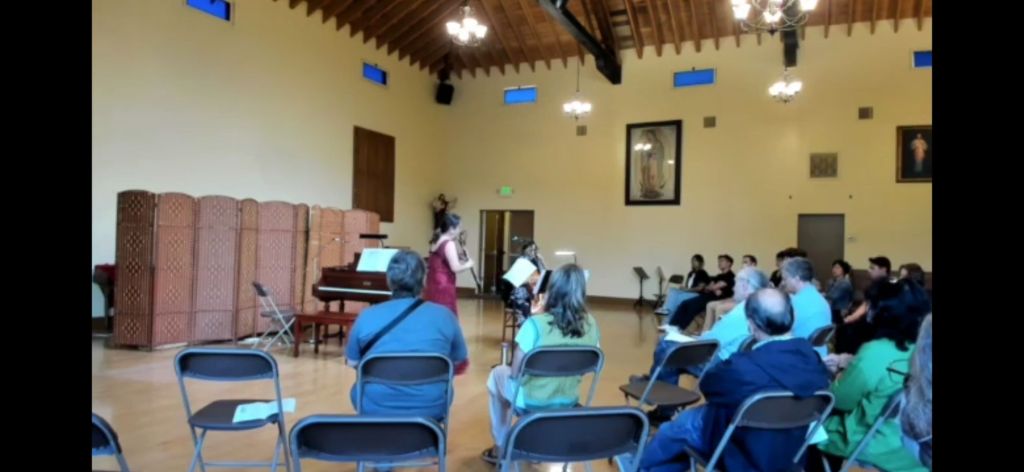
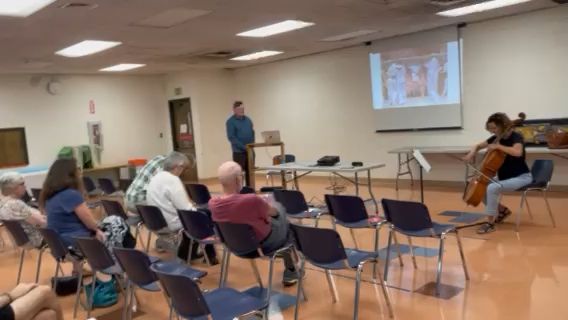


Hervé presents the mission of UP CLOSE AND CLASSICAL and that day’s repertoire to the audience of the 9/15/24 concert in Long Beach:
- A musical experience of time is analogous to a plein-air painter’s pictorial experience of space. For a fuller understanding of the musical experience of time, read Pierre Souvtchinsky’s 1939 article at this link ↩︎
- The history of music can be seen under the lens of the complementarity of musicality and musicianship. It then shows that the golden age of chamber music coincides with the only period in history when musicianship became more important than musicality. Before the baroque period, each culture had its own musicality, a marker of its identity. The theory and the performance of music were rarely in the same person. Theory was in the high society, among savants and philosophers, while slaves or servants were performing the music. After the Renaissance, music notation and the democratization of music instruments made music theory more accessible and gave birth in the 18th century to concepts such as “the composer” and “the concert”. Musicianship became the path to access new music, for listeners and performers alike. It did not last. Two centuries later, recorded music flipped again the balance. Today, being a successful musician requires appealing to the people’s musicality, not to their musicianship. And musicianship is no longer a necessary condition to be a significant actor in “the music market”. ↩︎
 UP CLOSE AND CLASSICAL