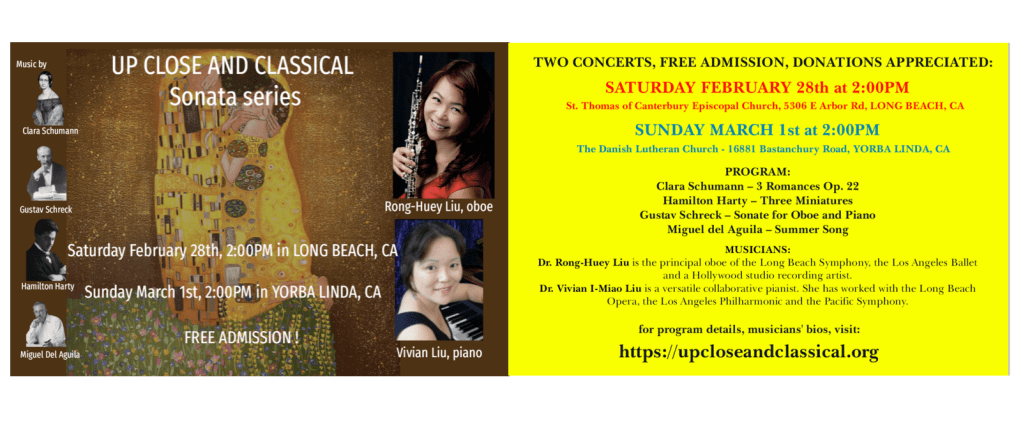
Program:
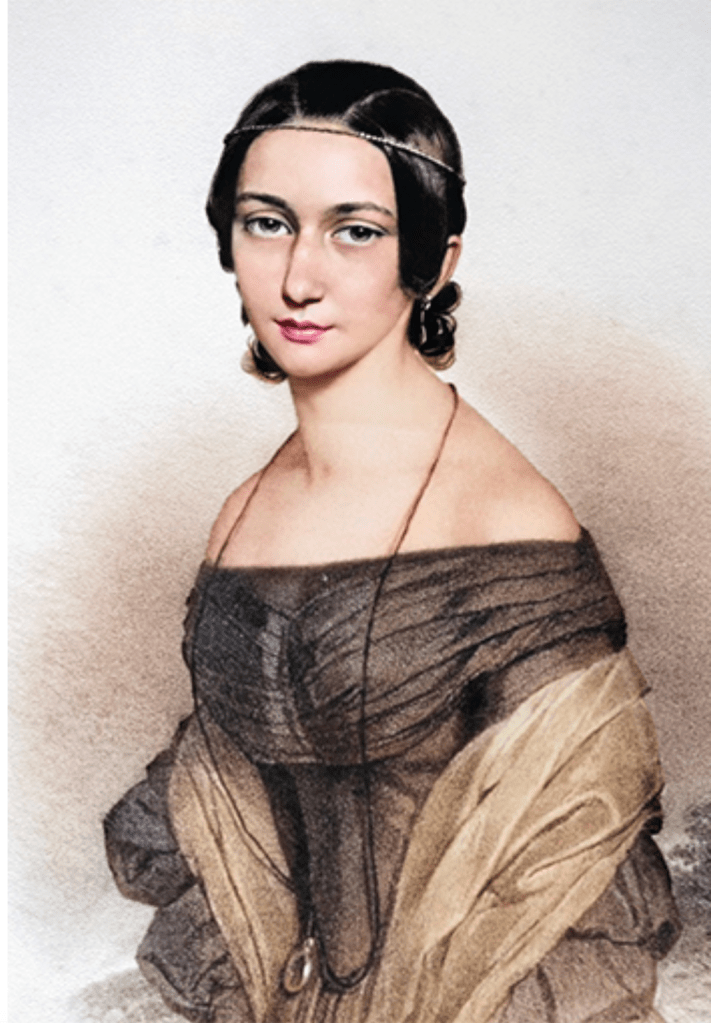
Clara Wieck Schumann (1819-1896), German
Three Romances, Op. 22 (1853) 9 minutes
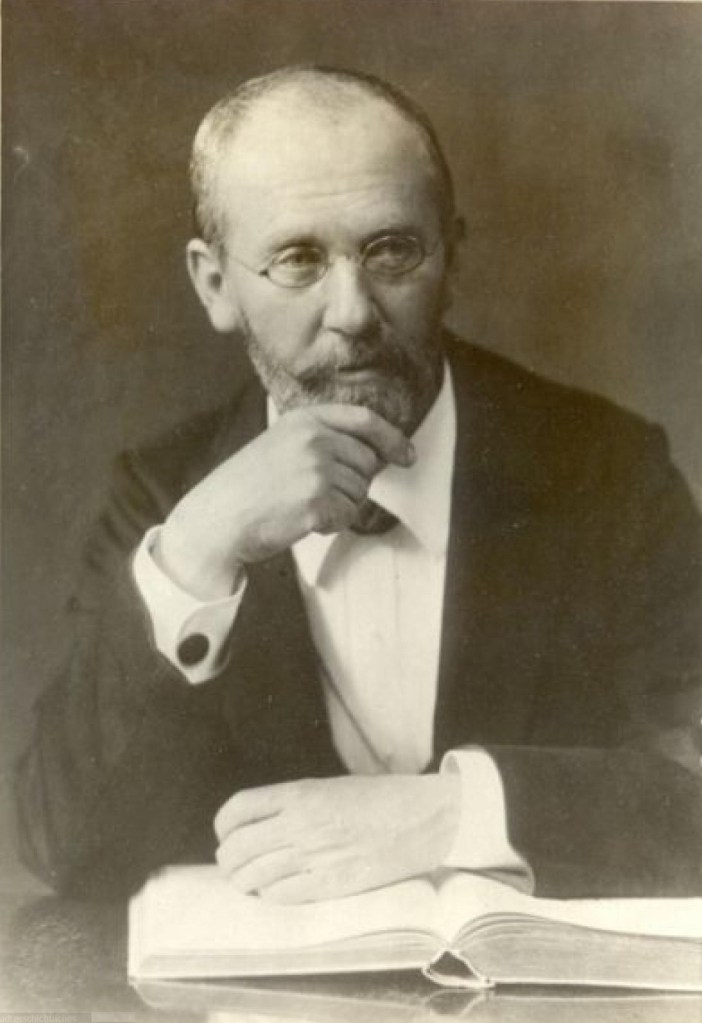
Gustav Ernst Schreck (1849-1918), German
Sonata op. 13 for oboe and piano (1889) 16 minutes
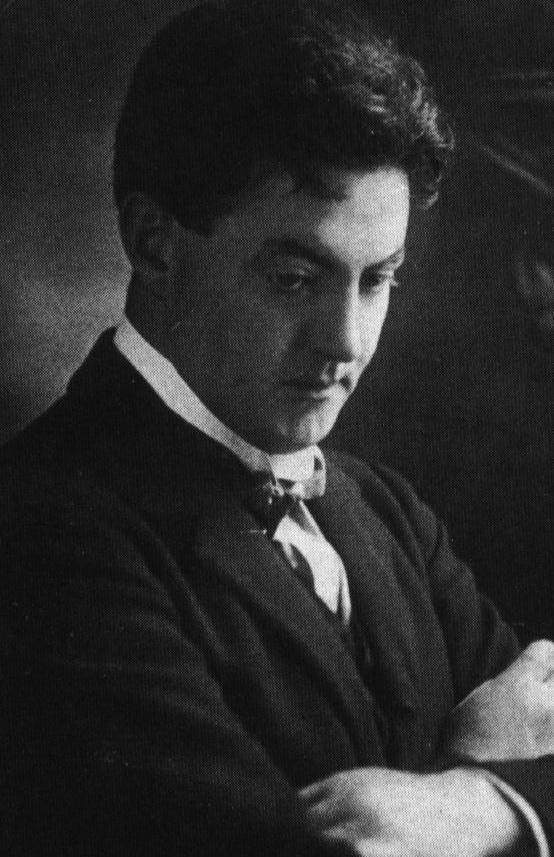
Sir Herbert Hamilton Harty (1879-1941), Irish
Three miniatures (1911) 14 minutes
Miguel DelAguila (born 1957), Uruguay/USA
Summer Song, Op. 26 for oboe and piano (1988, revised 1996) 14 minutes
Preview of program notes:
Clara Schumann’s “Three Romances”
History remembers Clara Schumann as the most famous pianist of her generation, the wife of composer Robert Schumann and close friend of Johannes Brahms. She stopped composing in 1853, for practical reasons. Her skills as a pianist better supported her family and promoted Robert’s legacy after his death. These “Three Romances” were written for violin and piano and dedicated to violinist Joseph Joachim, who played with Clara in many of the 1,300 concerts she performed over their 40-year friendship. In the 1970’s, these “Three Romances” were adapted for oboe and piano and entered this combination’s repertoire. The three movements are linked melodically and harmonically into one single piece of music.
Gustav Schreck’s Sonata for oboe and piano
Gustav Schreck held between 1892 and 1918 the position as Cantor of St Thomas’ Church in Leipzig, Germany, the same position Johannes Sebastian Bach had held 170 years earlier. He was also the director of music for the conservatory founded by Mendelssohn 50 years earlier (with Robert Schumann as a teacher). His output as a composer was therefore in choral music, as was Bach’s. But Leipzig was also a hub for high-quality wind playing, as reflected in the world-class wind section of the local Gewandhaus Orchestra. Schreck wrote this sonata for the Gewanhaus’ principal oboist Gustav Hinke (1844-1893).
Hamilton Harty’s “Three miniatures”
Sir Hamilton Harty is usually remembered as the conductor of the Hallé in Manchester after World War I, the orchestra’s first leader trained in the British Isles, not in Germany. He led many historic orchestral recordings between 1926 and 1933 when Columbia started to make quality classical music accessible to everyone through LPs. Hamilton Harty started his music career at age twelve as an organist for an Anglican parish (Church of Ireland), following in his father’s footsteps. He however moved to London at age 20, in 1900, became there known as “the prince of accompanists”, and was soon noticed as a composer. He wrote this “Three miniatures” for a then 14-year old oboist named Léon Goosens (we met Goosens as Britten’s and Moeran’s “muse” at our last concert). These “Three miniatures” are three distinct character pieces. Orientale uses the Phrygian mode to create a mysterious, “Eastern” atmosphere. Chansonette features a simple song-like melody showcasing the oboe’s lyrical beauty. À la Campagne is a spririted finale which evokes the French countryside.
Miguel Del Aguila “SUMMER SONG”
“The work is all about nature, how it affects us and how we interact with it. It was inspired by an Aztec poem that, though lost long ago, I still recall visually: It’s a quiet, warm and lazy summer afternoon and the protagonist is lying on the grass. As he daydreams, his thoughts interact with the actual landscape, creating a magical, unreal place. Soon, as passing clouds bring rain the protagonist falls asleep and dreams. As the storm passes birds begin to sing, waking him up”. The work opens with a gentle, modal theme, followed by a more lively and rhythmic second theme. Their interplay provides a gentle dialogue that takes us through a set of variations. The themes become agitated and trigger the “dream” section of the piece from where a bird seems to slowly guide us back to reality. The themes we heard at the beginning return and are later joined by a new, almost scandalous theme, reminiscent of Brazilian samba “Summer Song stands alone among my works due to its capricious form, its over-abundance of thematic material, and most of all for the disparity of styles which somehow seem to merge together: idioms ranging from Indian chant and the 1940s Big Band era coexist with the late Renaissance, Middle Eastern arabesques, music from the Caribbean and Brazilian Samba. Originally written in 1988, I revised the work in 1996, expanding it in both length and, alas, difficulty” (Notes by Miguel Del Aguila)

 UP CLOSE AND CLASSICAL
Leave a comment