Last November, ahead of our Mozart-Grieg concert, we had met Wolfgang Amadeus Mozart through anecdotes. This is a re-post of the first set of anecdotes, ahead of our new MOZART concert, this weekend:
Wolfgang Amadeus MOZART (1756-1791)
Son of the Kapellmeister to the Prince-Archbishop of Salzburg. Mozart spent his adult life in Vienna as a freelance musician. ‘I must tell you before God and as an honest man,’ declared Haydn to Leopold Mozart in 1785, ‘that your son is the greatest composer I ever heard of.
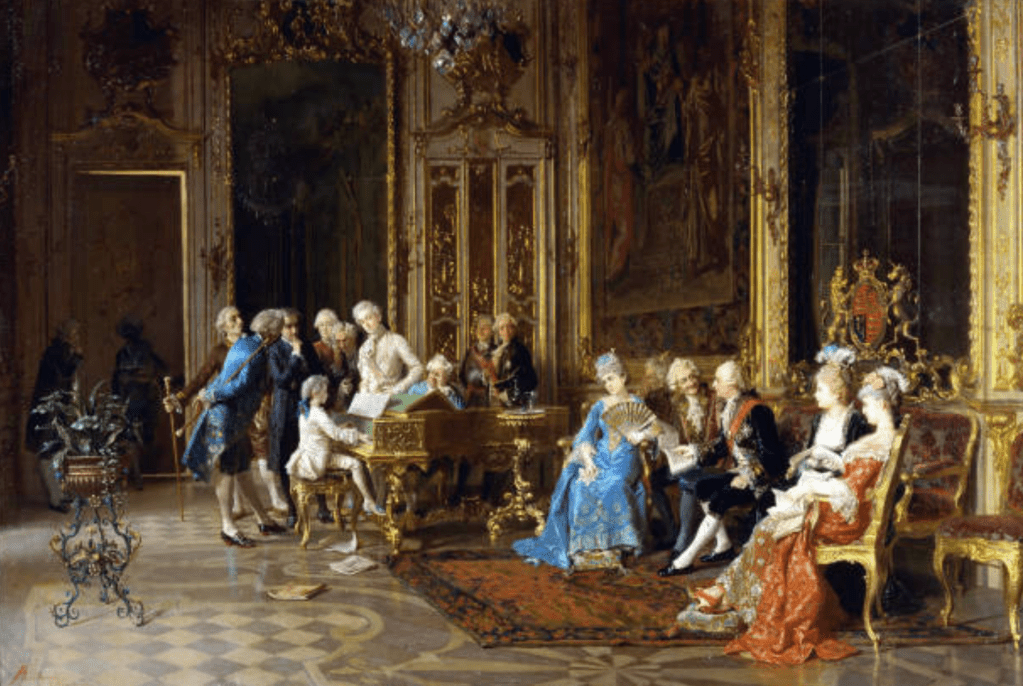
Letter to Mozart’s sister, Maria Anna, from Johann André Schachtner, court trumpeter at Salzburg, 24 April 1792
Once I went with your father after the Thursday service to your house, where we found Wolfgängerl, then four years old, busy with his pen.
Father: What are you doing?
Wolfg.: Writing a concerto for the clavier; it will soon be done.
Father: Let me see it.
Wolfg.: It’s not finished yet.
Father: Never mind; let me see it. It must be something very fine.
Your father took it from him and showed me a daub of notes, for the most part written over ink-blots. (The little fellow dipped his pen every time down to the very bottom of the ink-bottle, so that as soon as it reached the paper, down fell a blot; but that did not disturb him in the least, he rubbed the palm of his hand over it, wiped it off, and went on with his writing.) We laughed at first at this apparent nonsense, but then your father began to note the theme, the notes, the composition; his contemplation of the page became more earnest, and at last tears of wonder and delight fell from his eyes. ‘Look, Herr Schachtner,’ said he, ‘how correct and how orderly it is; only it could never be of any use, for it is so extraordinarily difficult that no one in the world could play it.’ Then Wolfgängerl struck in, ‘That is why it is a concerto; it must be practised till it is perfect; look! this is how it goes.’
He began to play, but could only bring out enough to show us what he meant by it. He had at that time a firm conviction that playing concertos and working miracles were the same thing.
——
‘I saw him,’ said Goethe, ‘at seven years old, when he gave a concert while travelling our way. I myself was about fourteen years old, and remember perfectly the little man, with his frisure and sword.’
——-
As the two archduchesses were one day leading the boy between them to the empress, being unused to the highly polished floor his foot slipped and he fell. One of them took no notice of the accident but the other, Marie Antoinette, afterwards the unfortunate Queen of France, lifted him up and consoled him. He said to her, ‘You are very kind, I will marry you.’ She related this to her mother, who asked Wolfgang how he came to form such a resolution. ‘From gratitude,’ he replied, ‘she was so good, but her sister gave herself no concern about me.
——
Maria Anna Mozart recalls
On 5 August [1764] we had to rent a country house outside London, in Chelsea, so that Father could recover from a throat ailment which brought him near to death…. While our father lay dangerously ill, we were forbidden to touch the piano. And so, to occupy himself, Mozart composed his first symphony [K16] for all the instruments of the orchestra.
——
Until he was almost ten years old, he had an insurmountable horror of the horn, when it was sounded alone, without other instruments; merely holding a horn towards him terrified him as much as if it had been a loaded pistol. His father wished to overcome this childish alarm, and ordered me* once, in spite of his entreaties, to blow towards him; but, O! that I had not been induced to do it. Wolfgang no sooner heard the clanging sound than he turned pale, and would have fallen into convulsions, had I not instantly desisted.
*Johann André Schachtner.
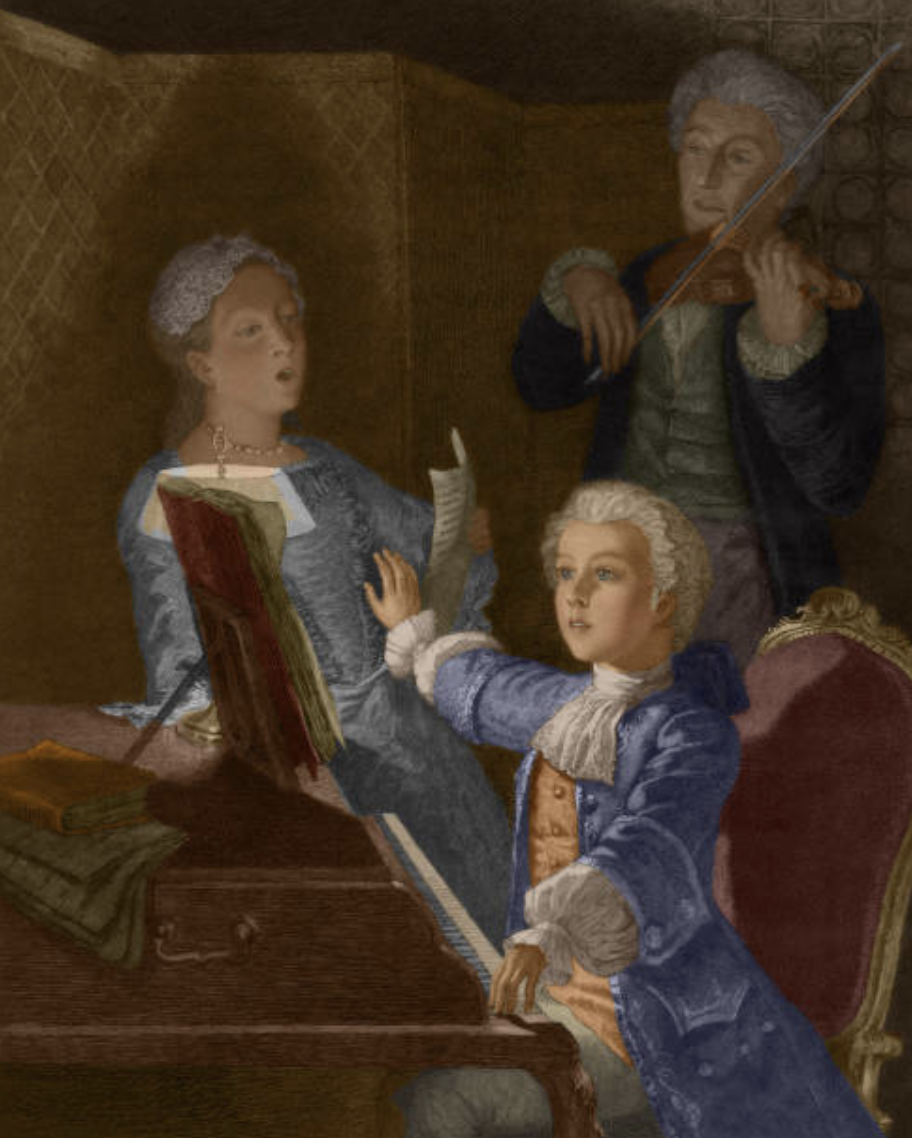

I* well remember a long illness, during which I attended (Constanze) for full eight months. I was at her bedside and Mozart likewise, composing – both of us as silent as the grave; for after much suffering she had just sank into a sweet and refreshing slumber. On a sudden a noisy messenger entered the apartment. Mozart, alarmed lest his wife should be disturbed, pushed his chair back and rose hastily, when the penknife, which was open in his hand, slipped and buried itself in his foot. Although very sensitive to pain on ordinary occasions, he was now silent; but beckoned me to follow him into another room, where I found that the wound was really a very serious one. Johannisöl, the surgeon, attended him, and he was cured without his
wife’s knowing that an accident had happened; although the pain made him for some time lame in walking.
*Sophie Haibl, Constanze Mozart’s sister.
——
Seeing the impossibility of altogether weaning Mozart from the habit of writing far into the night, and very often as he lay in bed in the morning, [his doctor] endeavored to avert the hurtful consequences in another way. He recommended him not to sit so long at the clavier, but at all events to compose standing, and to take as much bodily exercise as he could. His love of billiard-playing gave the doctor a welcome pretext for turning this motive into a regular one; Mozart was equally fond of bowls, and he was the more ready to follow the doctor’s directions with regard to both games since they did not interfere with his intellectual activity. It happened one day in Prague that Mozart, while he was playing billiards, hummed an air, and looked from time to time into a book which he had with him; it appeared afterwards that he had been occupied with the first quintet of The Magic Flute.
——
His barber used to relate in after-years how difficult it was to dress his hair, since he would never sit still; every moment an idea would occur to him, and he would run to the clavier, the barber after him, hair-ribbon in hand.
——
After hearing the rehearsal of The Abduction from the Seraglio which he had himself demanded of Mozart the Emperor Joseph II said to the composer, ‘My dear Mozart that is too fine for my ears; there are too many notes.’ ‘I ask your Majesty’s pardon, replied Mozart, ‘there are just as many notes as there should be.’
——
He was once required, in consequent of one of the general government orders frequent at Vienna, to deliver in a statement of the amount of his salary. He wrote, in a sealed note, as follows, ‘Too much for what I have done: too little for what I could have done.’
——
Mozart was one day accosted in the streets of Vienna by a beggar, who not only solicited alms of him, but by strong circumstances endeavored to make it appear that he was distantly related to him. Mozart’s feelings were excited; but being unprovided with money he desired the beggar to follow him to the next coffee-house, where, taking writing-paper, and drawing lines on it with his pen, he in a few minutes composed a minuet and trio. This, and a letter, Mozart directed him to take to his publisher, of whom the mendicant received a sum equal to five guineas.
——
The finest virtuosi and composers in Vienna would assemble at von Keess’ concerts where Haydn’s symphonies were performed; Mozart would play the piano, Jarnovick* would give a concerto and the mistress of the house sang. One evening Mozart, who had promised her a song, was late in arriving. One servant after another was sent to find him, and he was eventually located in a tavern. Mozart suddenly remembered that he had promised a song but had not written a note of it. He sent the servant for a sheet of paper and sat down to compose. When the song was finished he went to the concert.
‘Giovanni Marie Giornovichi (‘Jarnovick’] (c.1740-1804); virtuoso violinist.
——
Mozart found an old Salzburg acquaintance at Vienna in the person of the horn-player Joseph Leutgeb. …. He was a capital solo-player on the French horn, but was wanting in higher cultivation. Mozart was always ready to help him, but frequently made him the butt of his exuberant spirits. Whenever he composed a solo for him, Leutgeb was obliged to submit to some mock penance. Once, for instance, Mozart threw all the parts of his concertos and symphonies about the room, and Leutgeb had to collect them on all fours and put them in order; as long as this lasted Mozart sat at his writing-table composing.

All anecdotes are excerpts from Norman Lebrecht’s Book of Musical Anecdotes (The Free Press , NY, 1985)

 UP CLOSE AND CLASSICAL
Leave a comment