Hans Gal (1891-1987) saw his growing success as a comic operatic composer cut short in 1933 by the Nazi rule in Germany. His own writing and teaching reflected his will to communicate the joy of music-making.
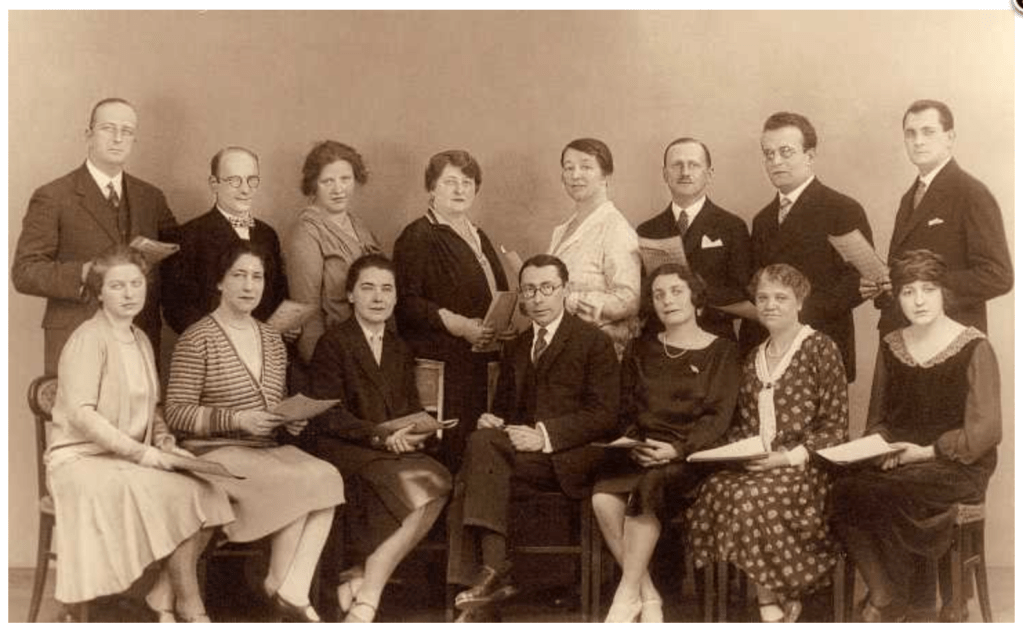
Vocal music played an essential role from the beginning. In 1927 he founded his own Madrigal Society, which was then the only choir in Vienna which performed a-capella works. Gál was considered to be “one of the first to bring about the renaissance of a-capella music-making through his own compositions.” [Erwin Kroll, p.175]. He himself wrote in an essay on ‘Vocal Chamber Music’:
What our musical life is in need of is … a revival of the joy of music-making, a fresh impetus for domestic music… The glories of the a-capella epoch have largely been made available in the last few decades by new editions. Here is a treasure to be unearthed for practical music which can be compared in importance to what musical life gained from the rediscovery of the life’s work of Johann Sebastian Bach. But above all there is in this area a task for the creative musicians of our own time, whose fulfilment could have an extraordinarily fruitful effect on the whole of musical development: a new vocal music is there to be created, music which, though born of the spirit of our time and using the newly acquired expressive possibilities, leads back to the long-buried sources of genuine vocal music, chamber music in the true sense of the word, which offers pleasure and stimulus not merely to listen but also to sing. [‘Vokale Kammermusik’, Musikblätter des Anbruch X, Vol. 9-10, 1928]
When appointed as director of the Mainz conservatory in 1929, Gal set out his goals for the conservatory in an article in the local press, which appeared only a few weeks after his appointment:
Even those who are already predisposed to music must, so to speak, be awakened to a higher, more intensive, truly artistic musical sensitivity, as musicians as well as listeners . . . This capacity for productive listening and experiencing, which I should like to call artistic receptivity, is, as any attentive observer can confirm, in serious decline today, in spite of all attempts to spread culture more widely. The main deficiency in this respect is, in brief, in the teacher’s ability to bring the musical work of art to life for the student to whom he is supposed to be conveying it . . . Real enthusiasm, true joy in music comes only from a masterpiece, never from something worthless or insignificant, which cannot satisfy anyone in the long run. Therefore bad music is much, much more damaging than is generally assumed, it destroys not merely taste but also indirectly the pleasures of music . . . Artistic sensitivity and musical enthusiasm can . . . only be learnt from the masterpieces of the great composers; and the best way to achieve it is naturally through practical music-making. [ Mainzer Anzeiger, 31.12.1929 ]
A vivid portrait of Gál’s own teaching is presented by Otto Schmidtgen, a student at the time – and much later a successor as director of the conservatory and a committed promoter of his music:
Gál’s teaching was extremely instructive, supported by comprehensive knowledge and an extraordinary familiarity with the literature, which still amazes me today. Teaching from such a lofty standpoint can hardly be fitted into a ‘timetable’ . . . It was never the case that only the work under discussion was mentioned, the horizon was very broad, so that for example in talking about the ‘Rosenkavalier’ problems were suddenly discussed which related to Bach and Mozart. The teaching had nothing schoolmasterly about it, but had rather the character of a friendly talk . . . We all sensed that he was a personality of a quite special stamp who stood head and shoulders above everyone else. [Waldstein, op. cit., pp. 91-2.]

 UP CLOSE AND CLASSICAL
Leave a comment