Franz Joseph HAYDN (1732-1809)
Haydn affectionately known as ‘Papa’ to his contemporaries – encouraged Mozart, taught Beethoven, and in his own compositions fathered the modern symphony and the string quartet.
The Austrian composer Dittersdorf and Haydn were friends as young men. One night while roaming the streets they stopped outside a common beer hall in which the musicians, half drunk and half asleep, were fiddling away miserably at a Haydn minuet…. ‘Let’s go in,’ proposed Haydn. ‘In we go!’ agreed Dittersdorf.
Entering the taproom, Haydn sat down beside the leader and asked casually, ‘Whose minuet?’ The man snapped, ‘Haydn’s.’ Haydn moved in front of him and, feigning anger, declared: ‘That’s a stinking minuet!’ ‘Says who?’ demanded the fiddler, jumping out of his seat with rage. The other musicians rallied round him and were poised to smash their instruments over Haydn’s head but Dittersdorf, a big fellow, shielded Haydn with his arm and pushed him out of the door.
——
In 1759 Haydn gained his first appointment as music director to Count Morzin in Vienna. He liked to tell in later years how, while he was sitting one day at the harpsichord, the beautiful Countess Morzin leaned over him to see the notes and her neckerchief came undone. ‘It was the first time I had seen such a sight; I became confused, my playing faltered, my fingers stuck to the keys. “What is it, Haydn? What are you doing?” cried the Countess. Very respectfully, I answered, “But your Grace, who would not be undone at such a sight?”
——
In Prince Esterhazy’s orchestra there were a number of vigorous young men who in summer, when the Prince stayed at Esterhaza, had to leave their wives behind in Eisenstadt. The Prince once prolonged his stay in Esterháza uncustomarily by some weeks: thoroughly dismayed, the loving husbands turned to Haydn for help. Haydn had the inspiration of writing a symphony… in which one instrument after the other falls silent. Each of the musicians was directed, as soon as his part was finished, to blow out his candle, put his instrument under his arm and walk out. The Prince and his audience immediately took the point. . . next day came the order to leave Esterháza.
Thus Haydn told Georg August Griesinger (1769-1845), his biographer, the origin of the ‘Farewell’ Symphony.
——
Many years afterwards when Haydn was in England, he perceived that the English, who were very fond of his instrumental compositions when the movement was lively and allegro, generally fell asleep during the andantes or adagios, in spite of all the beauties he could accumulate. He therefore wrote an andante, full of sweetness, and of the most tranquil movements; all the instruments seemed gradually to die away; but, in the middle of the softest pianissimo, striking up all at once, and reinforced by a stroke on the kettledrum, they made the slumbering audience start.†
†This work became known as the ‘Surprise’ Symphony.
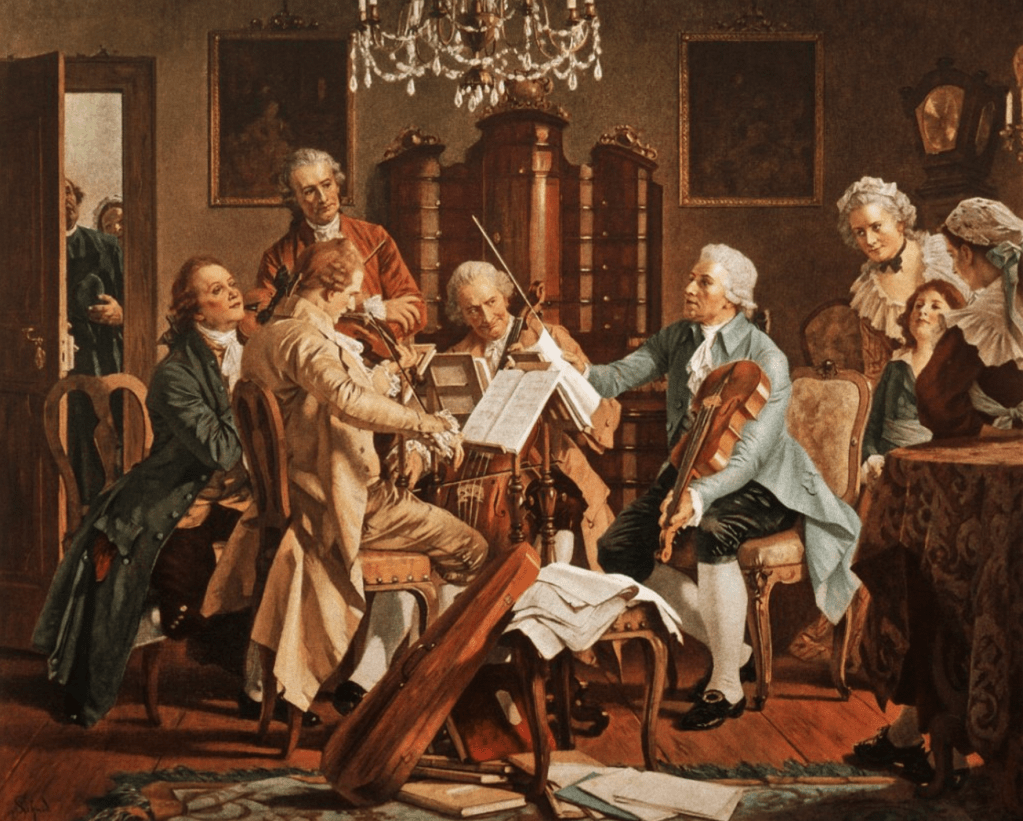
In his bedroom, he hung a set of twenty-four canons that he had composed. ‘I am not rich enough,’ said Haydn, ‘to buy good paintings, so I have found myself hangings that few others possess.’ When his wife complained one day that there was not enough money in the house to bury him if he died suddenly, Haydn replied, ‘If such a calamity occurs, take these canons to the publisher. I am sure they will cover a decent funeral.’
Georg August von Griesinger (1769-1845), official at Saxonian embassy in Vienna; biographer of Haydn.
——
‘Where Mozart is, Haydn cannot appear,’ he wrote, when invited at the same time as Mozart to Prague for the coronation of Emperor Leopold II.
——
On the eve of Haydn’s departure [for London], Mozart said: ‘Papa, (as he usually called him), ‘you have no education for the great world and you speak too few languages.’ ‘Oh!’ replied Haydn, ‘my language is understood all over the world.’… Mozart, that day, never left his friend Haydn. He dined with him and, when they parted, said, ‘We are probably saying our last adieu in this life.’ Tears welled in both men’s eyes. Haydn applied Mozart’s words to himself: it never occurred to him that Mozart’s life would be cut short the very next year.
——
One morning a neat little gentleman came into [Howell’s] shop and asked to look at some pianoforte music, and he laid before him some sonatas by Haydn which had just been published. The stranger turned them over and said, ‘No, I don’t like these.’ Howell replied, ‘Do you see they are by Haydn, Sir?’ ‘Well, Sir, I do, but I wish for something better.’ ‘Better,’ cried Howell indignantly, ‘I am not anxious to serve a gentleman of your taste,’ and was turning away when the customer made it known that he was Haydn himself. Howell, in astonishment, embraced him and the composer was so flattered by the interview that a long and intimate friendship followed.
——
Haydn, in his London notebooks
On 14 December I dined for the first time at the house of Mr Shaw. He received me below stairs at the door, and conducted me thence to his wife, who was surrounded by her two daughters and other ladies. While I was bowing all around I suddenly perceived that the lady of the house, besides her daughters and the other ladies, wore on their headdresses a pearl-coloured band, of three-fingers’ breadth, embroidered in gold with the name of Haydn, and Mr Shaw wore the name on the two ends of his collar in the finest steel beads. The coat was of the finest cloth, smooth, and bore beautiful steel buttons. The mistress is the most beautiful woman I ever saw. N.B. Her husband
wanted me to give him a souvenir, and I gave him a tobacco-box which I had just bought for a guinea. He gave me his in exchange. A few days afterward I visited him and found that he had had a case of silver put over the box I had given him, on the cover of which was engraved Apollo’s harp, and round it the words Ex dono celeberrimi Josephi Haydn. N.B. The mistress gave me a stickpin as a souvenir.
——
He related an anecdote of his dining in company with Mrs Billington*, at some house where there was a picture of her [by Sir Joshua Reynolds] hanging in the room, representing her listening to an angel singing; Haydn said it ought to be reversed – she ought to have been drawn singing and the angel listening to her; he got a kiss for this elegant compliment.
*Elizabeth Billington (1765-1818); English soprano.
——
At the end of the first part of the concert Haydn had the distinguished honour of being formally introduced to His Majesty George III, by His Royal Highness the Prince of Wales. My station at the time was so near to the King, that I could not avoid hearing the whole of their conversation. Amongst other observations, His Majesty said (in English), ‘Doctor Haydn, you have written a great deal. To which Haydn modestly replied, ‘Yes, Sire, a great deal more than is good.’ To which the King neatly rejoined, ‘Oh no, the world contradicts that.’
Frederik Samuel Silverstolpe, diplomat at Swedish embassy in Vienna.
——
He showed me his Aria in D from the Creation, which depicts the movements of the sea and the rising of the cliffs out of the sea. ‘Can you see,’ he said jokingly, ‘how the notes behave like waves? Up and down they go! Look, you can also see the mountains. You have to amuse yourself sometimes after being serious for so long.’
William Thomas Parke (1762-1847); English oboist.
——
In 1805 he became so debilitated and disabled, as to give birth to the report of his death. The Paris papers echoed the mortal announcement: and the National Institute (of which he was a member) acknowledged his claims to its honourable notice, by the celebration of a Mass to his memory. The intelligence of this amused him exceedingly: ‘O, why did not the learned and liberal body apprize me of their munificent intention, that I might be present to beat time to the performance of my own mortal rites.’
——
On 10 May [1809] in the morning a French army corps advanced to the Mariahlf line, not far from Haydn’s home. They were just getting him out of bed and dressed when four canister shots exploded. violently rattling the windows and doors of his house. He called out aloud to his frightened servants, ‘Don’t be afraid, children; where
Haydn is, no harm can reach you!’
——
On removing the body of the deceased composer from Gumpendorf to its present abiding place in Vienna, it was found minus the skull! Medical men, it seems, had noticed some ailment of the great master. Without entering into particulars, I* will merely state that, during my last visit to Vienna, in November 1873, I had the honour of
dining with the Baron Rokitanzky, the chief director of the great hospitals. After dinner, the Baron took me into his studio, and carefully placed in my hands a well-preserved relic – the missing skull of Papa Haydn.
** ** ** **
From Norman Lebrecht’s “Book of musical anecdotes”
 UP CLOSE AND CLASSICAL
Leave a comment