Antonín DVOŘÁK (1841-1904)
Czech composer whose immeasurably popular New World Symphony originated from three years (1892-5) spent in New York and among the Czech community of Spillville, Iowa.
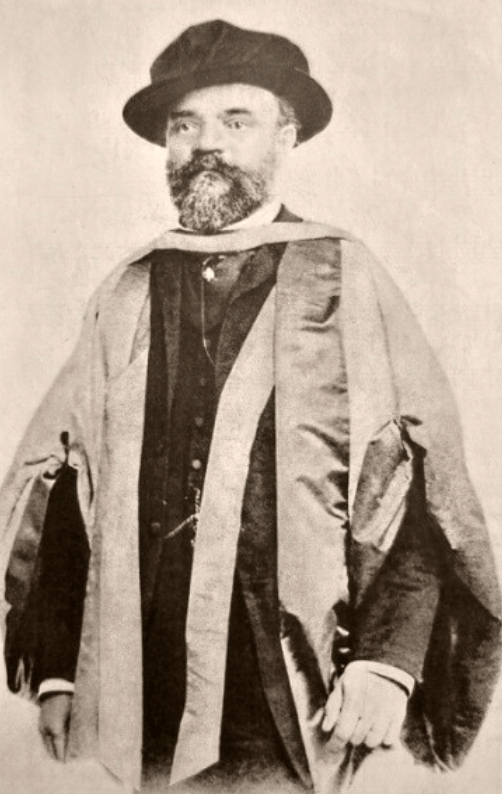
Old Borax, as Dvořák was affectionately called, was handed over to me* by Madame Thurber when he arrived [in New York]. He was a fervent Roman Catholic, and I hunted a Bohemian church for him as he began his day with an early Mass. Rather too jauntily I invited him to taste the American drink called a whisky cocktail. He nodded his head, that of an angry looking bulldog with a beard. He scared one at first with his fierce Slavonic eyes, but was as mild a mannered man as ever scuttled a pupil’s counterpoint. I always spoke of him as a boned pirate. But I made a mistake in believing that American strong waters would upset his Czech nerves. We began at Goerwitz, then described a huge circle, through the great thirst belt of central New York. At each place Doc Borax took a cocktail. Now, alcohol I abhor, so I stuck to my guns, the usual three-voiced invention, hops, malt, and spring water. We spoke in German, and I was happy to meet a man whose accent and grammar were worse than my own. Yet we got along swimmingly – an appropriate enough image, for the weather was wet, though not squally. I left him swallowing his nineteenth cocktail. ‘Master,’ I said, rather thickly, don’t you think it’s time we ate something?’ He gazed at me through those awful whiskers which met his tumbled hair half-way, ‘Eat. No. I no eat. We go to a Houston Street restaurant. You go, hein? We drink the Slivovitch. It warms you after so much beer.’ I didn’t go that evening to the East Houston Street Bohemian café with Dr Antonín Dvořák. I never went with him. Such a man is as dangerous to a moderate drinker as a false beacon is to a ship-wrecked sailor. And he could drink as much spirits as I could the amber brew. No, I assured Mrs Thurber that I was through with piloting him. When I met Old Borax again at Sokel Hall, the Bohemian resort on the East Side, I deliberately dodged him.*James Huneker (1860-1921), prominent New York critic; Jeanette M. Thurber, wealthy grocer’s wife who founded National Conservatory of Music and engaged Dvořák as its director.
What the Master missed in America were his pigeons and locomotives. He felt the want of these two ‘hobbies’ very much, but here, too, he at length found a modest substitute. One day we went with the Master to the Central Park where there is a small Zoological Garden and buildings with different kinds of birds. And then we came to a huge aviary with about two hundred pigeons. It was a real surprise for the Master and his pleasure at seeing the pigeons was great and even though none of these pigeons could compare with his ‘pouters’ and ‘fantails’, we made the trip to Central Park at least once and often twice a week. With locomotives it was a more difficult matter. In New York at that time, there was only one station the others were across the river (the city of New York is situated on the island of Manhattan). At the main station they did not allow anybody on to the platform except the passengers. and it was in vain that we begged the porter to let us look at the ‘American locomotive’. We travelled by overhead tram to 155th Street, a good hour from the Master’s house, and there, on a bank, waited for the Chicago or Boston express to go by. Only it took up a lot of time, nearly the whole afternoon, as we always waited for a number of trains so that it would be worth the journey… And then the Master found a new hobby in steamships. For one thing the harbour was much nearer and then, on the day of departure, the public was allowed on board, an opportunity which the Master made full use of. There was soon not a boat that we had not inspected from stem to stern. The Master always started a conversation with the ship’s captain or with his assistants, and so, in a short time, we knew all the captains and mates by name. And when a ship was due to sail we went there and watched it from the shore till it was out of sight.
———-
Brahms tried to persuade Dvořák to move to Vienna and, because he knew that he had a big family, he said, ‘Look here, Dvořák, you have a lot of children and I haven’t almost anybody. If you need anything. my fortune is at your disposal.’ The tears came into Mrs Dvořák’s eyes and Dvořák, deeply touched, seized the Master’s hand. Then the conversation turned to faith and religion. Dvořák, as is well known was possessed of a sincere and almost child-like faith, whereas Brahms’ views were quite the opposite. ‘I have read a lot of Schopenhauer and look on things differently,’ he remarked…. On the way to the hotel, Dvořák was more than usually silent. At last after some considerable time he exclaimed, ‘Such a man, such a soul and he doesn’t believe in anything, he doesn’t believe in anything!’
———-
Fritz Kreisler called on Dvořák in 1903 in his impoverished home in Prague ‘It was like a scene from La Bohème,’ Kreisler remembered. ‘Dvořák was lying in bed, sick and in visibly bad shape. He had sold all his compositions for a mere pittance and now had nothing to live on. Even the emoluments for his brilliant American tour had for some reason or other been used up. ‘I had been playing some of Dvořák’s Slavonic Dances and visited the old man to pay him my respects. I asked him whether he had nothing further for me to play. “Look through that pile,” the sick composer said, pointing to a mass of unorganized papers. “Maybe you can find something.” I did. It was the Humoresque.”
 UP CLOSE AND CLASSICAL
Leave a comment