Ludwig van BEETHOVEN (1770-1827)
Born in Bonn of Flemish ancestry, he moved in 1792 to Vienna. Beethoven’s music, personality and the events of his life assumed almost mythological proportions during the nineteenth century: he was considered the apotheosis of genius and creator.
A quartet from Beethoven’s Opus 18 will be featured at our next concerts on June 29-30 :
In Bonn [when Beethoven was a boy] there was a middle-aged man by the name of Stommb who had formerly been a musician and learned to compose. Thereby, it was said, he had become insane; he used to wander through the town with a conductor’s wand in his right hand and a music roll in his left; not a word would he say. When he came into the ground floor at Rheinstrasse 934, where no one had thought to see him, he would strike with his wand on the table…and point up towards the Beethovens’ home as if to indicate that musicians were there, too, and then beat time with the conductor’s wand on the music roll, not saying one word. Ludwig van Beethoven often laughed about it and once said, ‘We can see by that how it goes with musicians; music has already made this one mad – what may happen to us?’
When [Griesinger]† was still only an attaché, and Beethoven was little known except as a celebrated pianoforte player, both being still young, they happened to meet at the house of Prince Lobkowitz, In conversation with a gentleman present, Beethoven said in substance, that he wished to be relieved from all bargain and sale of his works, and would gladly find some one willing to pay him a certain income for life, for which he should possess the exclusive right of publishing all he wrote; adding, ‘and I would not be idle in composition. I believe Goethe does this with Cotta, and, if I mistake not, Handel’s London publisher held similar terms with him.” ‘My dear young man,’ returned the other, ‘You must not complain; for you are neither a Goethe nor a Handel, and it is not to be expected that you ever will be; for such masters will not be born again.’ Beethoven bit his lips, gave a most contemptuous glance at the speaker, and said no more.
† Georg August von Griesinger (1769-1845); later to become Saxon Minister in
Vienna, biographer of Haydn.
He seemed to think strangeness and originality the chief objects to be aimed at in composition, as appears from his answer to a lady who asked whether he frequently attended Mozart’s operas, that ‘he was not acquainted with them, and did not care to hear other than his own music, lest he should impair his originality.”
In whatever company he might chance to be, he knew how to produce such an effect upon every hearer that frequently not an eye remained dry, while many would break out into loud sobs; for there was something wonderful in his expression in addition to the beauty and originality of his ideas and his spirited style of rendering them. After ending an improvisation of this kind he would burst into loud laughter and banter his hearers on the emotion he had caused in them. ‘You are fools!’ he would say…. ‘Who can live among such spoiled children!’ he would cry.
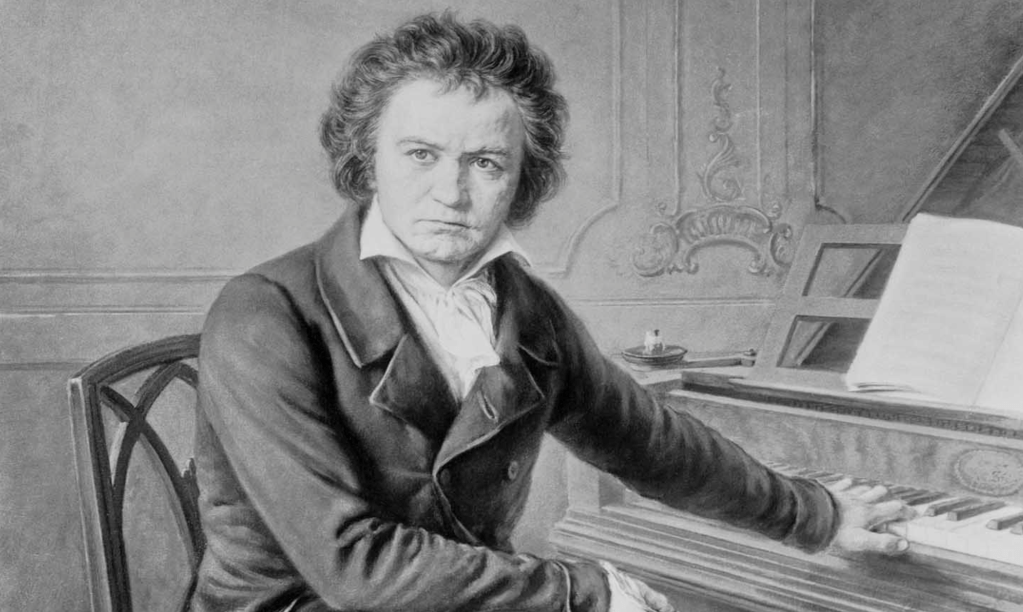
In 1802, facing the gradual onset of deafness, Beethoven gave expression to his appalling predicament in a document found among papers after his death, the so-called Heiligenstadt Testament:
FOR MY BROTHERS CARL AND [JOHANN] BEETHOVEN
Oh, you men who think or say that I am malevolent, stubborn, or misanthropic, how greatly do you wrong me. You do not know the secret cause which makes me seem that way to you. From childhood on, my heart and soul have been full of the tender feeling of goodwill, and I was ever inclined to accomplish great things. But, think that for six years now I have been hopelessly afflicted, made worse by senseless physicians, from year to year deceived with hopes of improvement, finally compelled to face the prospect of a lasting malady (whose cure will take years or, perhaps, be impossible).
Though born with a fiery, active temperament, even susceptible to the diversions of society, I was soon compelled to withdraw myself, to live life alone. If at times I tried to forget all this, oh how harshly was I flung back by the doubly sad experience of my bad hearing. Yet it was impossible for me to say to people, ‘Speak louder, shout, for I am deaf.’ Ah, how could I possibly admit an infirmity in the one sense which ought to be more perfect in me than in others, a sense which I once possessed in the highest perfection, a perfection such as few in my profession enjoy or ever have enjoyed. Oh I cannot do it; therefore forgive me when you see me draw back when I would have gladly mingled with you. My misfortune is doubly painful to me because I am bound to be misunderstood; for me there can be no relaxation with my fellow men, no refined conversations, no mutual exchange of ideas. I must live almost alone, like one who has been banished; I can mix with society only as much as true necessity demands. If I approach near to people a hot terror seizes upon me, and I fear being exposed to the danger that my condition might be noticed. Thus it has been during the last six months which I have spent in the country. By ordering me to spare my hearing as much as possible, my intelligent doctor almost fell in with my own present frame of mind, though sometimes I ran counter to it by yielding to my desire for companionship. But what a humiliation for me when someone standing next to me heard a flute in the distance and I heard nothing, or someone heard a shepherd singing and again I heard nothing. Such incidents drove me almost to despair; a little more of that and I would have ended my life – it was only my art that held me back. Ah, it seemed to me impossible to leave the world until I had brought forth all that I felt was within me. So I endured this wretched existence – truly wretched for so susceptible a body, which can be thrown by a sudden change from the best condition to the very worst. Patience, they say, is what I must now choose for my guide, and I have done so – I hope my determination will remain firm to endure until it pleases the inexorable Parcae to break the thread. Perhaps I shall get better, perhaps not; I am ready. Forced to become a philosopher already in my twenty-eighth year, – oh it is not easy, and for the artist much more difficult than for anyone else. Divine One, thou seest my inmost soul; thou knowest that therein dwells the love of mankind and the desire to do good. Oh fellow men, when at some point you read this, consider then that you have done me an injustice; someone who has had misfortune may console himself to find a similar case to his who despite all the limitations of Nature nevertheless did everything within his powers to become accepted among worthy artists and men. You, my brothers Carl and [Johann], as soon as I am dead, if Dr Schmidt is still alive, ask him in my name to describe my malady, and attach this written document to his account of my illness so that so far as is possible at least the world may become reconciled to me after my death. At the same time, I declare you two to be the heirs to my small fortune (if so it can be called); divide it fairly; bear with and help each other. What injury you have done me you know was long ago forgiven. To you, brother Carl, I give special thanks for the attachment you have shown me of late. It is my wish that you may have a better and freer life than I have had. Recommend virtue to your children; it alone, not money, can make them happy. I speak from experience; this was what upheld me in time of misery. Thanks to it and to my art, I did not end my life by suicide – Farewell and love each other – I thank all my friends, particularly Prince Lichnowsky and Professor Schmidt – I would like the instruments from Prince L. to be preserved by one of you, but not to be the cause of strife between you, and as soon as they can serve you a better purpose, then sell them. How happy I shall be if I can still be helpful to you in my grave so be it. With joy I hasten to meet death. If it comes before I have had the chance to develop all my artistic capacities, it will still be coming too soon despite my harsh fate, and I should probably wish it later – yet even so I should be happy, for would it not free me from a state of endless suffering? – Come when thou wilt, I shall meet thee bravely. Farewell and do not wholly forget me when I am dead; I deserve this from you, for during my lifetime I was thinking of you often and of ways to make you happy – please be so –
LUDWIG VAN BEETHOVEN (seal)
 UP CLOSE AND CLASSICAL
Leave a comment