The “Schubertiads”
There were Schubert evenings when wine flowed generously, when the good Vogl sang all those lovely Lieder and poor Franz Schubert had to accompany him endlessly so that his short and fat fingers would hardly obey him any longer. It was even worse for him at our* social entertainments, only Würstelbälle (hot-dog parties) in those frugal times, but with no lack of charming ladies and girls. Here our ‘Bertl’, as Schubert was familiarly called by his friends, was made to play, and play again and again, his latest waltz until the endless cotillon was finished and the small, corpulent and freely perspiring little man could finally take a rest and eat his modest dinner. Small wonder that he sometimes fled and some ‘Schubertiads’ had to take place without Schubert.
* The narrator is Eduard von Bauernfeld; Austrian playwright, translator of Dickens.
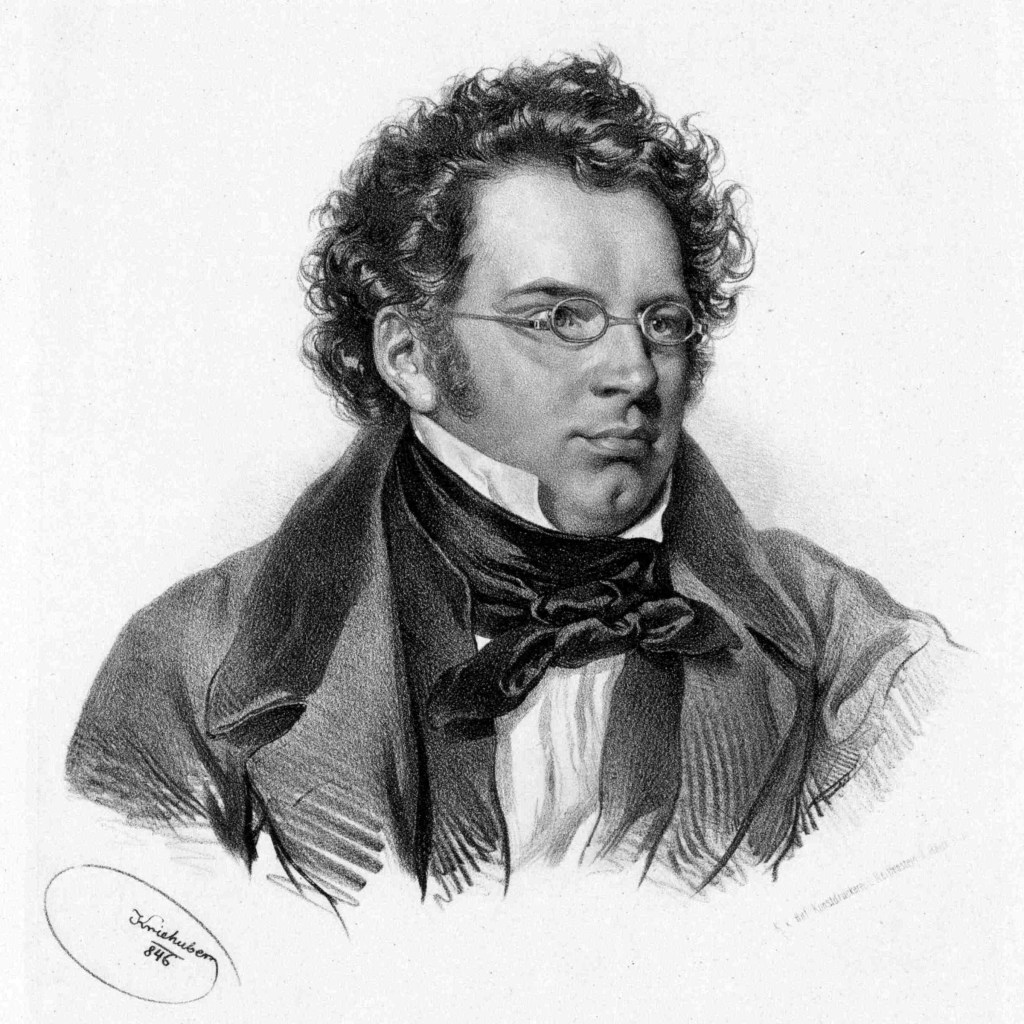
Schubert, one morning, brought [Michael Vogl] several songs for perusal. The singer was busy at the moment, and put off the musician to another time; the songs were laid aside. Vogl afterwards examined all the songs at his leisure. . One that pleased him particularly was too high for him, so he transposed it, and had a fresh copy made, About a fortnight elapsed, and the two artists and friends were enjoying music together. Something new was proposed, and Vogl, without saying a word further, placed [the song] in the handwriting of the transposer upon the piano. When Schubert heard the composition in its transposed state, he called out with exultation, in the Viennese dialect, ‘H’m! pretty good song. Whose is it then?’
In the winter of 1827, on a visit to Vienna with his teacher Hummel, Ferdinand Hiller* heard Michael Vogl sing Schubert songs with the composer as accompanist. The sixteen year-old Hiller watched in astonishment as Hummel, ‘with half a century of music behind him’, wept openly throughout the recital. Determined to meet the unknown composer, Hiller next morning searched him out in his sparsely-furnished rooms. When he entered, Schubert was working, standing up beside a broad, high desk. ‘You compose a great deal,” exclaimed Hiller, seeing mounds of fresh manuscript scattered around. I compose every morning,’ replied Schubert seriously. ‘When one piece is finished, I begin another.’*(1811-85); German composer and conductor.
He once called on [Bendedikt] Randhartinger and asked him for the loan of fifteen florins to pay the rent of his lodgings, in order to avoid being turned out. Randhartinger at once gave him the necessary sum, and they both went to the proprietor and paid the fifteen florins. As they passed the ‘Graben’, the street where the music publisher Diabelli had his shop, Schubert said: ‘Dear Benedictus, I would repay you at once if these people here could pay me for my songs; they have a great many of my compositions, but every time I ask for money they always say they had too much outlay and too little income from my songs. I called twelve times at Diabelli’s, but I have not yet received one penny; but I shall never give them a song again.’ He sold Diabelli the copyright of twelve volumes of his songs for 800 florins; while on one single song, the ‘Wanderer’, Diabelli is said to have made a profit of no less than 36,000 florins.
Among the 20,000 mourners who followed Beethoven’s coffin on 29 March 1827, was Franz Schubert. After the ceremony at the Währing cemetery Schubert and his friends went to an inn to have a drink. Schubert lifted his glass and his first toast was ‘to him whom we have buried!’ At the second glass he said: ‘to him who will go next!’. Twenty months later, on 19 November 1828, Schubert was dead, aged only thirty-one.
*These five anecdotes are from Norman Lebrecht’s “The book of musical anecdotes”
 UP CLOSE AND CLASSICAL
Leave a comment